

A clear website structure decides whether visitors, and these days AI too, immediately understand what you do. Yet at many companies that structure keeps growing with every new service, until nobody knows exactly where to find what. A classic organizing principle from the consulting world helps: MECE. In this blog you will read what MECE is, why it matters right now, how to organize from your visitor’s point of view instead of your org chart, and how to apply it to your services and your menu in five steps (with ready-to-use AI prompts).
What is MECE, in plain language?
MECE is an organizing principle from McKinsey and stands for Mutually Exclusive, Collectively Exhaustive (Wikipedia). In plain language: you divide your offering into categories that do not overlap (every service belongs in exactly one place) and that together cover everything (nothing gets left out). No duplication, no gaps.
Why website structure matters even more now
Structure has always mattered for ease of use and for your findability. But with the rise of AI search engines it becomes decisive. An AI reads your site through its structure, its headings and the connections between pages to understand what you do and for whom. Overlapping or vague pages leave a model unsure which page answers which question. A clear, MECE structure helps both the visitor and the AI place your offering at a glance. Good information architecture remains human work (Nielsen Norman Group).
What a messy website structure costs you
On your own website you notice the effects of an unclear structure right away, even though they rarely show up in a single number. A visitor who cannot find what they are looking for within a few seconds clicks away to a competitor who does make it clear. A landing page that overlaps with three other pages competes with itself in Google, so none of them ranks well. And an AI search engine that is not sure which page is about what simply leaves you out of the answer. So a weak structure leaks visitors, findability and revenue, every single day. The good news: a few hours of thinking can fix it.
Organize around your visitor, not your org chart
The biggest mistake in website structure is that companies arrange their offering the way they are organized internally (departments, services, technology) instead of the way their visitor thinks. And that visitor is not one single type. Different people arrive with a different question, and your categories have to work for all of them:
- The owner-director is not looking for a “service” but for a solution to a problem: “I want more inquiries” or “I want an overview”. They scan your menu for results, not for technology.
- The marketing manager at a larger organization has a specific search: a platform, an integration, proof that you can handle her type of project. She wants to get to the right section fast.
- The startup founder thinks in terms of a concrete goal (“have a website built”) and gives up on a menu full of jargon.
- The loyal, small client is looking for maintenance, a small extension or support, and needs to find it immediately without feeling too small to matter.
A MECE structure only works once the categories match the language and the question of these people. That is why we organize part of our own site around visitor goals instead of services alone (see our solutions). Do not test your setup against your org chart, but against this question: would every persona find what they are looking for here within ten seconds?
Applying MECE: a concrete example
Say an installation company created separate pages over the years: boiler, heat pump, maintenance, breakdowns, sustainability advice and quote. Some overlap (maintenance and breakdowns), others are not a service at all but an action (quote). With MECE, three clear categories emerge:
- Installation: boiler, heat pump
- Maintenance and service: maintenance, breakdowns
- Advice: sustainability advice
“Quote” is not a category but a button that appears everywhere. The menu gets shorter, the visitor finds things faster, and every page has one clear purpose.
Five steps to a MECE website
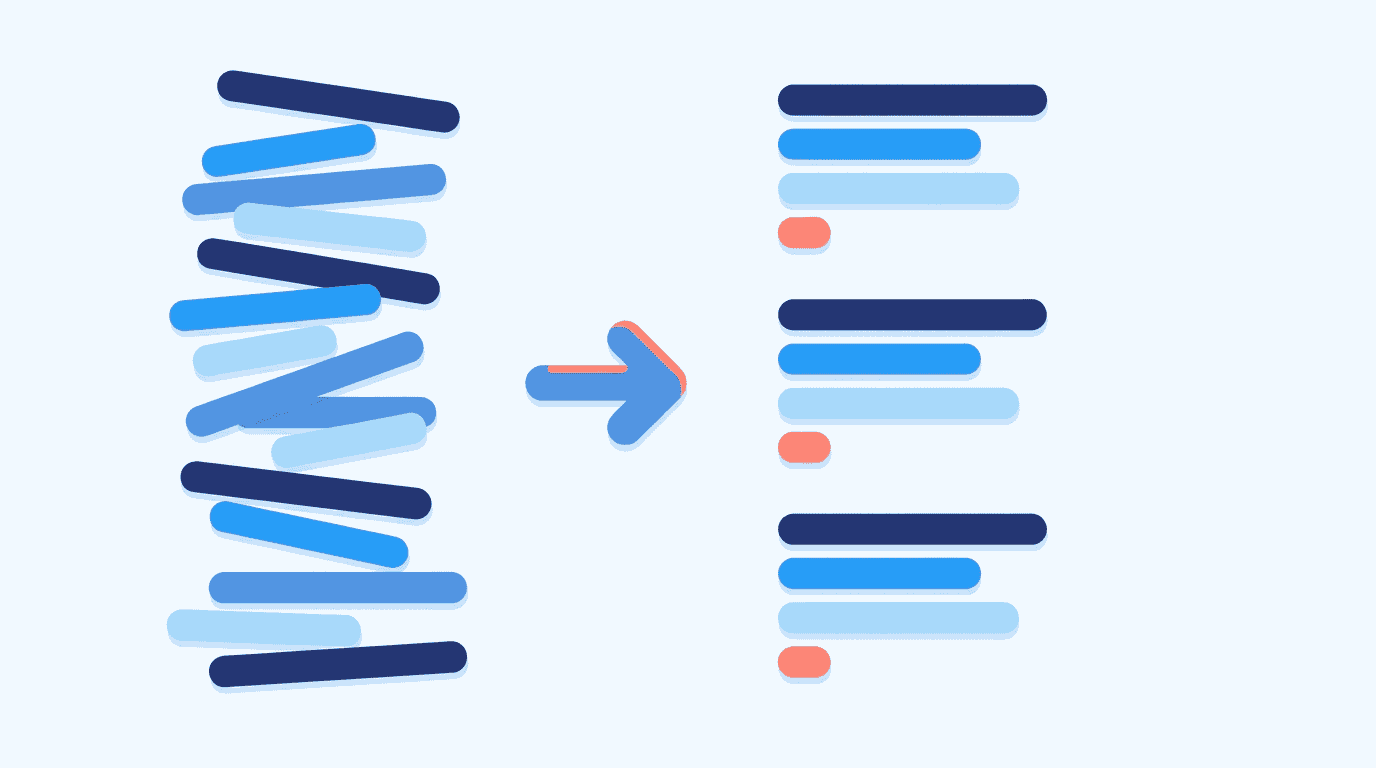
- Inventory everything. List every service, page and action, without judging.
- Group into main categories. Look for the natural clusters and aim for three to five.
- Check for overlap. If something fits in two categories, sharpen the definition until it belongs in only one place.
- Check for completeness. If something falls outside, add a category or revise your setup.
- Separate services from actions. Quote, contact and appointment are not categories but buttons. Keep them out of your main structure.
Run the MECE analysis with AI: prompts you can use right away
AI is a strong sparring partner for finding overlap and gaps in your website structure, as long as you direct it well. Work through these prompts in order and fill in the parts between the brackets:
- Clustering: “Here is a list of all my services, pages and actions: [paste list]. Group them into three to five main categories that do not overlap and together cover everything (MECE). Set actions such as quote or contact aside as buttons, not as categories.”
- Checking for overlap: “Check this setup for overlap: does any item belong in more than one category? If so, propose a sharper definition so that every item fits in exactly one place. Setup: [paste setup].”
- Checking for completeness: “Do these categories together cover my entire offering, or is something left out? Name what is missing and where it should go. Setup: [paste setup].”
- Checking from the visitor’s point of view: “My most important visitors are: [describe 2-3 personas in one sentence each]. For each persona, go through the first question they arrive with, and assess whether they find the right category within ten seconds. Where they do not, what needs to change?”
- Sharpening menu labels: “For each main category, give a short, recognizable menu label in the language my target audience uses itself, without jargon. Categories: [paste categories].”
One important note: AI delivers a first draft, not a final verdict. The final choice remains human work, because you are the one who knows your customers and your market.
The master prompt: your full MECE analysis in one go
Want to skip the separate prompts and get a complete structural analysis in one go? Copy the prompt below into your AI tool (ChatGPT, Claude or another), paste in your current page overview, and you will get a proposal plus a check on overlap, gaps and recognizability.
You are an information architect. Help me make my website structure MECE:
no overlap, no gaps.

My company: [in one sentence, what you do]
My current pages, services and actions: [paste the full list]
My most important visitors: [2-3 personas, each in one sentence: who + the first question
   they arrive with]

Deliver back:
1. 3 to 5 main categories that are mutually exclusive and together cover everything, with the
   matching pages per category.
2. A separate list of 'actions' (quote, contact, appointment) that become buttons, not categories.
3. An overlap check: which items fit in more than one category, and how do you solve that?
4. A gap check: what is still missing from my offering or structure?
5. Per persona: do they find the right category within 10 seconds? If not, what needs to change?
6. A short, jargon-free menu label per main category in the language of my target audience.

First ask at most 3 clarifying questions if anything is unclear.
That way you get a well-founded structure in one move, which you then only have to test against your own knowledge of your customers.
Have you settled on the new structure? Then you can also have your AI set up that menu layout and those pages directly as a draft in WordPress, instead of dragging everything into place by hand. To learn how to connect AI to your site, read WordPress management in 2026: put AI to work.
Rule of thumb: can you place every new service in exactly one spot without hesitating? Then your structure is MECE. If you hesitate, your categories still overlap.
What a clear website structure delivers
A MECE structure makes your site calmer and clearer. Visitors find what they are looking for faster, which helps your conversion. Search engines and AI place your pages better, because every page covers one clear topic. And internally, maintenance gets easier: you always know where a new page belongs. It is an investment of a few hours of thinking that serves your site for years.
Frequently asked questions about website structure
What does MECE mean?
MECE stands for Mutually Exclusive, Collectively Exhaustive. Mutually exclusive means your categories do not overlap, so every service or page belongs in exactly one place. Collectively exhaustive means the categories together cover your entire offering, so nothing gets left out. In short: no duplication and no gaps. It is an organizing principle from consulting firm McKinsey, but it works just as well for a small business website as for a strategy report.
How do I know whether my website structure fits my target audience?
Test your setup from your visitor’s point of view, not from your departments or your org chart. Describe your two or three most important personas and, for each one, go through the first question they arrive with. If they find the right category within about ten seconds, in the language they use themselves and without jargon, you are in good shape. If they have to search or hesitate, your categories do not yet match how your audience thinks, and you should sharpen the labels or the setup.
Isn’t MECE overkill for a small company?
No, quite the opposite. Smaller companies in particular tend to build their site step by step: every new service adds a page, and overlap and sprawl creep in. A few hours of MECE thinking gives you a short, clear menu that visitors and AI search engines understand immediately. You do not have to build anything complicated for it; it is mostly about thinking carefully about where each service belongs.
How many main categories should I have?
Usually three to five. Fewer than three gets too coarse, so categories lump too many different things together; more than five gets cluttered and waters down your menu. More important than the exact number is that the categories are mutually exclusive (no overlap) and together cover your entire offering (no gaps). Actions such as quote, contact or appointment do not count as categories: those are buttons that appear everywhere.
Why does website structure help my findability in AI?
AI search engines read your site through its structure, its headings and the connections between pages to understand what you do and for whom. Clear, non-overlapping pages make it easy for a model to pick exactly your page as the answer. Overlapping or vague pages leave an AI unsure which page answers which question, and when in doubt it leaves you out of the answer. So a MECE structure increases your chance of being visible both in Google and in AI answers.
Ready to work on your website structure?
A clear website structure with MECE makes your offering understandable to people and AI alike, and that pays off in ease of use, findability and conversion. Curious how MECE would work out on your site? Take the Growth Check: free, 30 minutes and no obligation. We will help organize your offering into a structure that makes sense.
Rather hand it off? See how we help with having a website built and UI/UX design.
More articles
- Easily optimize your website for voice search 24 June 2019
- Local SEO tips: how to improve your local findability 2 December 2024
- SEO trends for 2025: what you need to know 30 October 2024