

A marketing plan doesn’t have to be a forty-page document. For most business owners a one-page plan is enough, as long as it answers five questions. These are the same questions we ask when we look at the new year with clients. Answer them now and you start January with a plan instead of a to-do list.
At the bottom you’ll find a worked example and a fill-in table you can copy straight away.
What is a marketing plan?
A marketing plan describes what you’ll do in the coming year to win and keep customers: through which channels, with what budget, when, and who does it. A marketing strategy is the direction (who you’re there for, why they choose you). The plan is how you carry out that direction for one year.
Question 1: Where did your customers really come from this year?
Start with what has already happened, not with what you hope. List this year’s new customers or inquiries and note where each came from: Google, an ad, a referral, social media, a trade fair.
Where to find the numbers
- Google Analytics: under Acquisition you see per channel how many visitors filled in a form or bought something.
- Your own administration or CRM: ask every new customer how they found you, and write it down.
- Your ad accounts: Google Ads and Meta show per campaign what it delivered, if conversion tracking is set up properly.
Does a large share come in as “referral” or “don’t know”? That’s an outcome in itself: your tracking is missing something, and that goes into your plan.
Question 2: What did a customer cost per channel, and what did they bring in?
Per channel, divide what you spent (money and hours) by the number of customers it brought. Next to that, put what an average customer is worth. That way you see at a glance which channel pays for itself.
Read more about what ads really cost in Google Ads costs: what do you really pay?.
Question 3: What changes in 2027 that affects you?
Three developments that matter for almost every business owner, and one for anyone hiring staff:
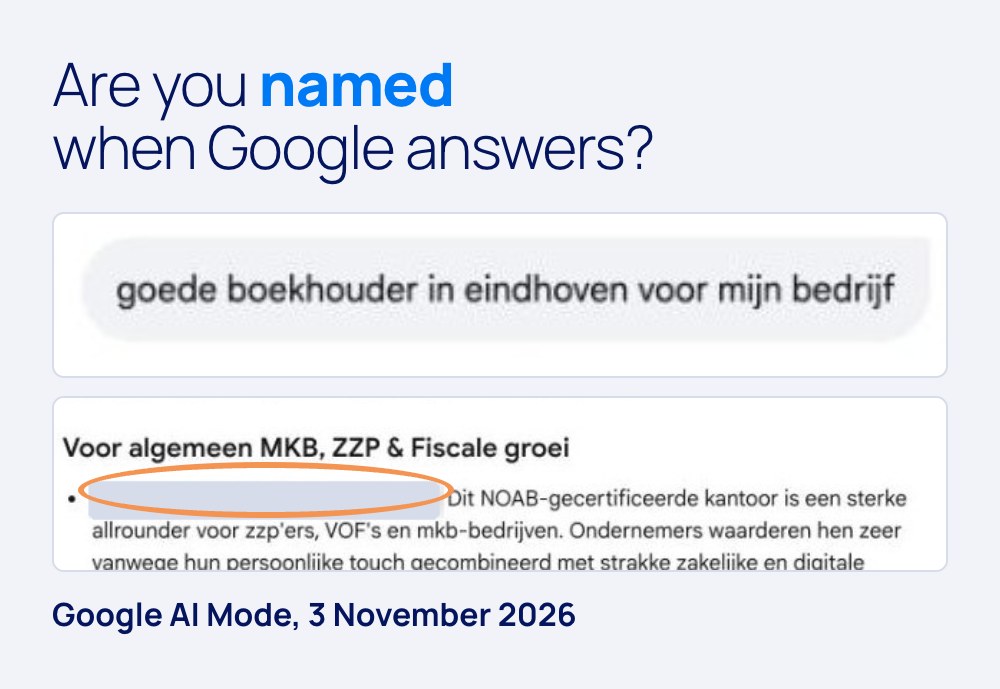
People also search with AI
Google has an AI mode in the Netherlands that writes an answer itself, and more and more people ask ChatGPT. Regular search results stay important, but being named in such an answer gives you an extra chance to be found. What that means for your site, read in Google AI Mode: what it means for you.
Your tracking has to be right
Not every visitor accepts cookies, so your numbers never show everything. Don’t only look at Google Analytics, but also ask every new customer how they found you. The better your tracking, the more reliable your choices in questions 4 and 5.
Security belongs in your plan
Leaks in software are found faster and faster, also with the help of AI. Put in your plan who looks after your website and accounts, and who has access. How we deal with this, read in Security incident: how we handle it.
Hiring? Salary in your job ad
The Dutch government wants to introduce the Pay Transparency Act, with 1 January 2027 as the intended date. The bill follows the European pay transparency directive: applicants get information about the starting salary or pay range in advance. The date depends on parliament, so keep an eye on the news and plan time to update your vacancies. (HR Praktijk)
Question 4: What will you stop doing?
This is the question that gets skipped most often. A channel that delivered little costs money or time you might better spend elsewhere. First look at why it disappointed: do customers take long to decide, is it measured properly, or did you put too little into it? If there’s no good reason, cut it. Unsure? Give it one more quarter with a clear goal and stop if it isn’t met.
Question 5: What will you do per quarter, with what budget and who does it?
Split the year into four quarters. Put at most three actions per quarter, each with an amount and a name. Plan the busy periods of your sector first (for a webshop the last weeks of the year, for hiring January and September) and work back from there.
How much budget?
There’s no fixed percentage that’s right for everyone. Start from question 2: what does a customer cost and what are they worth? Then you know how much you can spend per customer and how many extra customers you want.
Example: a one-page marketing plan
A made-up example: an installation company with twelve employees in Brabant. A job brings in € 900 gross margin on average. The numbers are for illustration.
| Channel | Customers | Cost | Per customer |
|---|---|---|---|
| Google Ads | 34 | € 12,000 a year | € 353 each |
| Website (SEO) | 21 | € 4,200 a year | € 200 each |
| Referral | 18 | € 900 a year | € 50 each |
| Flyers | 2 | € 1,500 a year | € 750 each |
| Trade fair | 3 | € 4,000 a year | € 1,333 each |
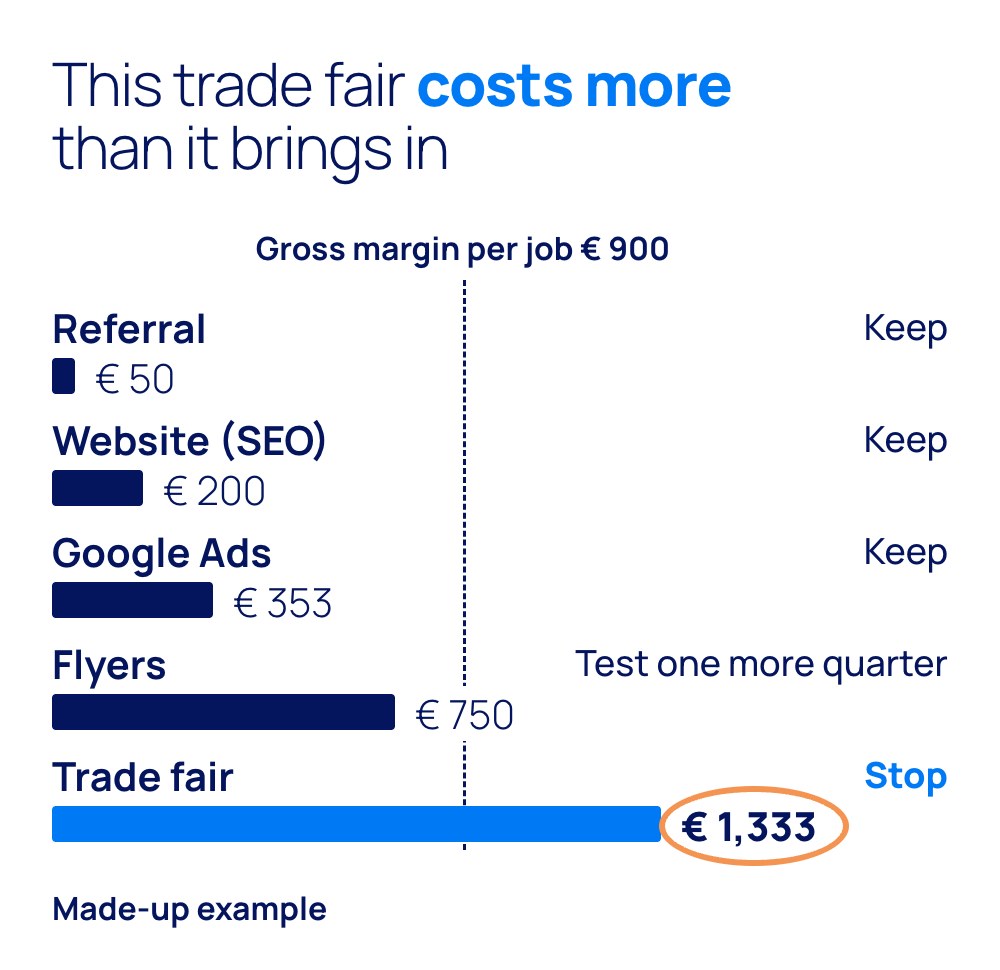
What this company decides:
- Google Ads and SEO: keep. A customer costs € 200 to € 353 and brings in € 900. Google Ads gets 20% more budget.
- Referral: the cheapest customer. A review request after every job, so it happens more often.
- Flyers: € 750 per customer leaves little. One more quarter with an offer and its own phone number, so it can be measured.
- Trade fair: € 1,333 per customer is more than a job brings in. Stop.
The plan per quarter:
- Q1: automate review requests, test flyers with their own number.
- Q2: two new service pages for the towns where most inquiries come from.
- Q3: scale up Google Ads for the autumn, two-step verification for all employees.
- Q4: put the year’s numbers next to this plan and make the plan for 2028.
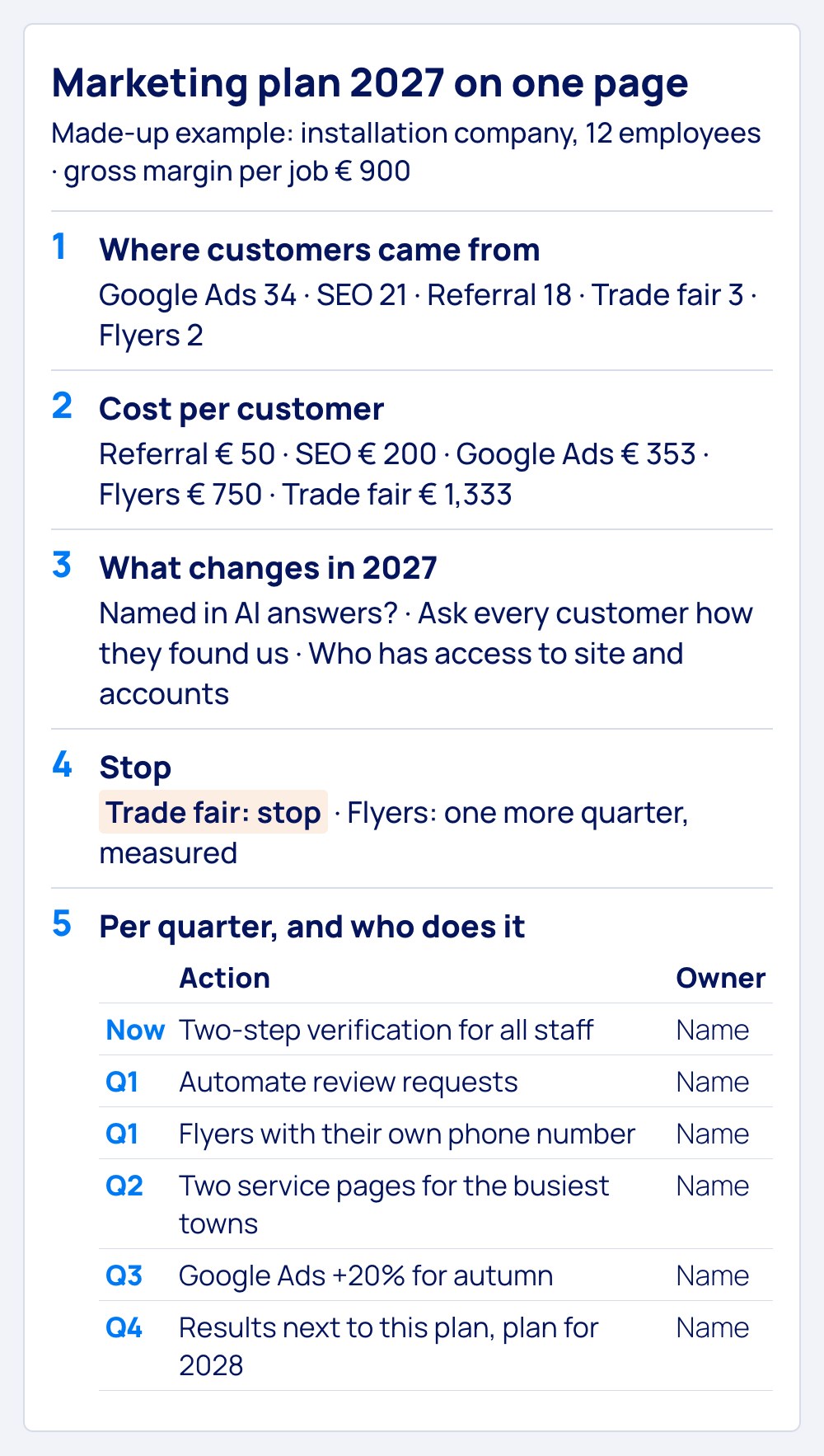
Fill-in table to copy
| Channel | Cost 2026 | Customers 2026 | Per customer |
|---|---|---|---|
Below it, write what a customer brings in on average, and per quarter at most three actions, each with an amount and a name.
Make your plan together
Rather not do this alone? Plan a meeting with us: a call, at your office or coffee at ours. We bring the numbers we have from you, you bring your answers to these five questions. After that you know what you’ll do in 2027, and what we can pick up for you.
Want a first look before we meet? Start with our free website scan.
Frequently asked questions
How long should a marketing plan be?
For most small and medium businesses one page is enough: the five answers, a table per channel and a plan per quarter. Longer is only needed if several people or departments have to carry it out.
What is the difference between a marketing strategy and a marketing plan?
The strategy is the direction: who you’re there for and why they choose you. The plan is what you concretely do this year to make that direction real, with budget, planning and who does it.
When do you make a marketing plan?
Preferably in November or December, so you can start in January. Look back briefly every quarter and adjust.