

What is the meaning of conversion?
A conversion happens when visitors to your website or online store complete a specific goal, often making a purchase. You can also calculate your conversion rate. Online marketing agency DoubleSmart explains it like this: “The conversion rate, or conversion ratio, is the ratio between the number of visitors to a website and the people who completed a predefined goal. That can be a purchase, but other goals are possible too.” Say you have 1,000 visitors a month on your website and 10 of them make a purchase. Your conversion rate is then 1%. A related concept is conversion optimization, also known as Conversion Rate Optimization (CRO). “By applying CRO you focus on removing obstacles in a website or online store, so visitors move to a purchase or a contact request better, faster and more easily. This lets you increase your success and your impact” (ThinkOrange, n.d.).
How can I calculate my conversion rate?
Above we already gave a short example of how the rate is calculated. Your best option is to use a tool that gives you insight into your conversions. Research by W3Techs shows that Google Analytics is a widely used tool. The simplest technique for getting a clear view of your conversion rate is to create a ‘thank you’ page. You link that page to your form or shopping cart and then track it in Google Analytics.
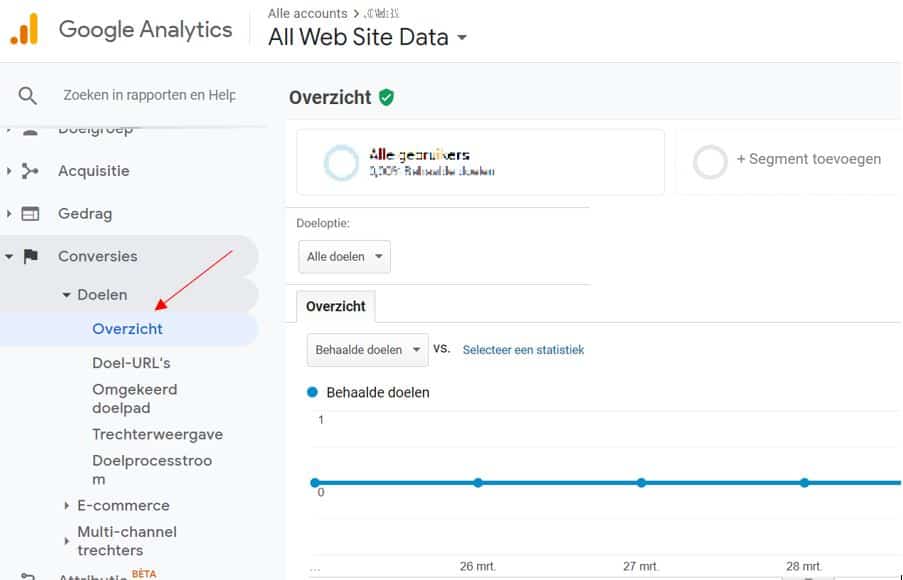
You can learn an enormous amount about your website or online store with this (free) tool. Not only what your conversion rate is, but also who your visitors are and how they behave on your site. You can analyze your audience: where are they located and which device do they use? Acquisition as well: how do visitors end up on your website? And behavior: what do visitors do on your site? You can see which page gets the most visits, what people search for, and which pages visitors often leave again. And of course the subject of this blog: conversion. For example, you can select a period and see the revenue and conversion ratio (WPLounge, n.d.).
So what is the perfect rate?
Rates differ across industries. In the travel industry the numbers look different than in higher education, for example. But as Jurjen Jongejan writes on Frankwatching: “Do not fixate on benchmarks.” In his blog he explains that the rate also depends on the type of product you sell. The type of visitor matters too. Are they mostly browsing, or do they actually intend to buy something? The goals of your visitors play a role as well. Do they want to request a quote, or are they only checking your opening hours? A conversion rate depends on a huge number of factors, which is why a reliable average is hard to calculate.

How can I increase my conversion rate?
First you need to determine what is going wrong or what needs to improve. Analyze your pages: where are the opportunities and the points to improve? Collect data about your website and your visitors, for example with Google Analytics. One of the most important parts of conversion is making sure visitors do not drop out halfway through the buying process. So make sure your website or online store is fast and easy to use, so customers reach the checkout sooner. And if visitors do leave your website, try to bring them back. Send them an email reminding them that they still have products in their cart, for example. Or offer the option to sign up for a newsletter, so they stay up to date on your products or services. Here are a few more practical tips you can apply right away:
- Place plenty of contact forms across different pages;
- Create clear call-to-action (CTA) buttons;
- Use the right color for your CTA buttons and pick contrasting colors;
- Measuring is knowing! Start A/B testing. A/B testing means you test 2 different variants of specific pages or page elements. Which version performs better, and is therefore the one you keep? This only gets interesting at larger volumes, so when your website gets a lot of visitors. A test with 100 visitors a month is far less reliable than one with 10,000 visitors a month, because a larger sample gives you a broader picture of your audience and the results fluctuate less.
- Show social proof. Add reviews or the logos of references, for instance;
- Use a live chat or WhatsApp. That is a lower barrier way for customers to get in touch than calling or emailing

We help you with your conversion rate optimization (CRO)
Would you like more help increasing your conversions? We consider CRO extremely important, and you can see that in our projects. ‘Measuring is knowing’, which is why we track this on every website. Having a beautiful website or online store is great, but as an entrepreneur you of course want to do business and actually sell your products or services. We are happy to help you with that. A pretty website is not the same as an effective and profitable one. That happens to be our specialty, so contact us today to discuss the options with no strings attached.
Rather hand it off? See how we help with having a website built and a digital strategy.
More articles
- Why social proof is essential for trust and conversion 2 March 2026
- Local SEO tips: how to improve your local findability 2 December 2024
- What is Google Analytics 4 (GA4): and other frequently asked questions 29 August 2022