
Since August 24, 2026 you can advertise inside ChatGPT in the Netherlands. It is the kind of news that rolls through your entire timeline within a week, with as many celebration stories as doomsday scenarios. We first worked out what is really for sale, what it costs and for whom the math already adds up. Short answer: for most Dutch companies this is not yet a channel to shift budget into, but it is the clearest signal so far that your visibility in AI answers is worth money from now on. In this blog you will read exactly what is and is not possible, why the answer is different for B2B than for B2C, and what we are advising our clients this month.
What exactly went live on August 24
OpenAI has rolled out ChatGPT Ads in 31 European markets, including the Netherlands (OpenAI). That brings the channel to Europe roughly six months after the first American test. Ads appear below the ChatGPT answer, are labeled as sponsored and sit visually apart from the answer itself. They are not visible to everyone: only users on the free version and on the Go plan see them. Anyone using Plus, Pro, Business, Enterprise or Edu sees nothing. Users under 18 are excluded.
More important than the news itself is the fine print: you cannot yet advertise on your own in Europe. There is no self-service environment yet. Buying runs through OpenAI’s Ads Solutions team, through agency partners or through technology partners, and signing up at ads.openai.com is no guarantee of access. So anyone claiming they will start tomorrow is in practice buying a conversation with a sales team, not a campaign.
Where you can buy yourself, and where you cannot
It pays to keep those two things separate, because they are constantly mixed up. “ChatGPT Ads is available in the Netherlands” means that Dutch users are shown ads. It does not mean you can switch those ads on yourself.
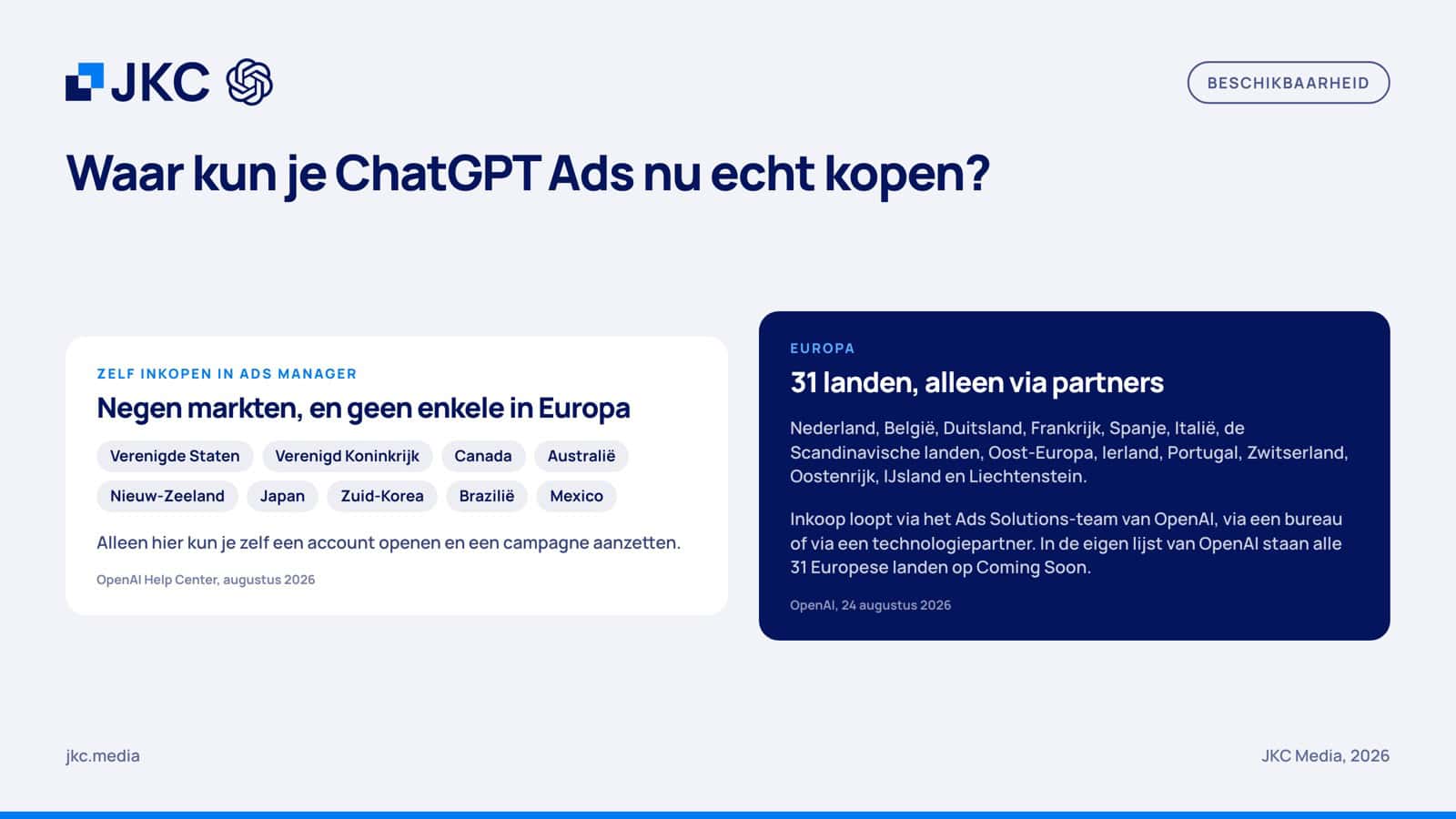
Buying through Ads Manager yourself is currently possible in nine markets: the United States, the United Kingdom, Canada, Australia, New Zealand, Japan, South Korea, Brazil and Mexico. Only there can you open an account and put a campaign live without an intermediary (OpenAI Help Center).
The European rollout covers 31 countries: the Netherlands, Belgium, Luxembourg, Germany, France, Spain, Portugal, Italy, Austria, Switzerland, Liechtenstein, Ireland, Iceland, Denmark, Sweden, Norway, Finland, Estonia, Latvia, Lithuania, Poland, Czechia, Slovakia, Hungary, Slovenia, Croatia, Romania, Bulgaria, Greece, Cyprus and Malta. In all of those countries users see the ads, but buying runs through OpenAI’s Ads Solutions team, through agency partners or through technology partners. OpenAI announced self-service for Europe later this summer, without a concrete date.
So for a Dutch company there are practically three routes: wait until Ads Manager opens up here, buy through a partner now with the minimum commitments that come with it, or advertise through an entity in one of those nine markets. We do see that third route come up in the market, but targeting is still tied to the country you are buying in, so it is rarely the shortest path.
Two formats, and why that distinction matters
There are currently two ad formats, and they immediately give away what type of company this channel was built for:
- Product ads with an image, a title and a price. You know the pattern from Google Shopping: a card with a specific product and a specific amount.
- Service and accommodation ads with an image, a headline and a description, optionally as a carousel with several options side by side.
You can buy on CPM, on CPC and on a conversion-optimized CPC. You can target by country, work with custom audiences and pass along your own context hints. Measurement runs through UTM parameters, the OpenAI pixel, a Conversions API and third-party measurement. The estimated click price in the Netherlands is around 2 to 3 euros, while OpenAI itself quotes 3 to 5 dollars (Frankwatching). For a new channel that is not a shocking amount, but it is no bargain either.
From keyword to conversation
The real change is not in the format but in the matching. You do not bid on a keyword. Your ad is matched to what the conversation is about. That difference is bigger than it sounds, because it moves your presence to a different moment in the customer journey.
In Google you show up at the moment someone has already compressed their question into three words. In ChatGPT you show up while someone is still formulating: “what is a good alternative to X”, “what should I look out for if I want to buy Y”, “which company can do this in the Rotterdam area”. That is the orientation phase, not the checkout moment. For anyone used to judging their ads on last-click conversions, that is an awkward place to stand, and that is exactly why we are cautious about it: the channel delivers influence on a choice that is completed later, elsewhere and along a different path.
The figures that should be driving the discussion
Plenty of figures get thrown around about AI search that nobody can back up. We stick to three that can be traced.
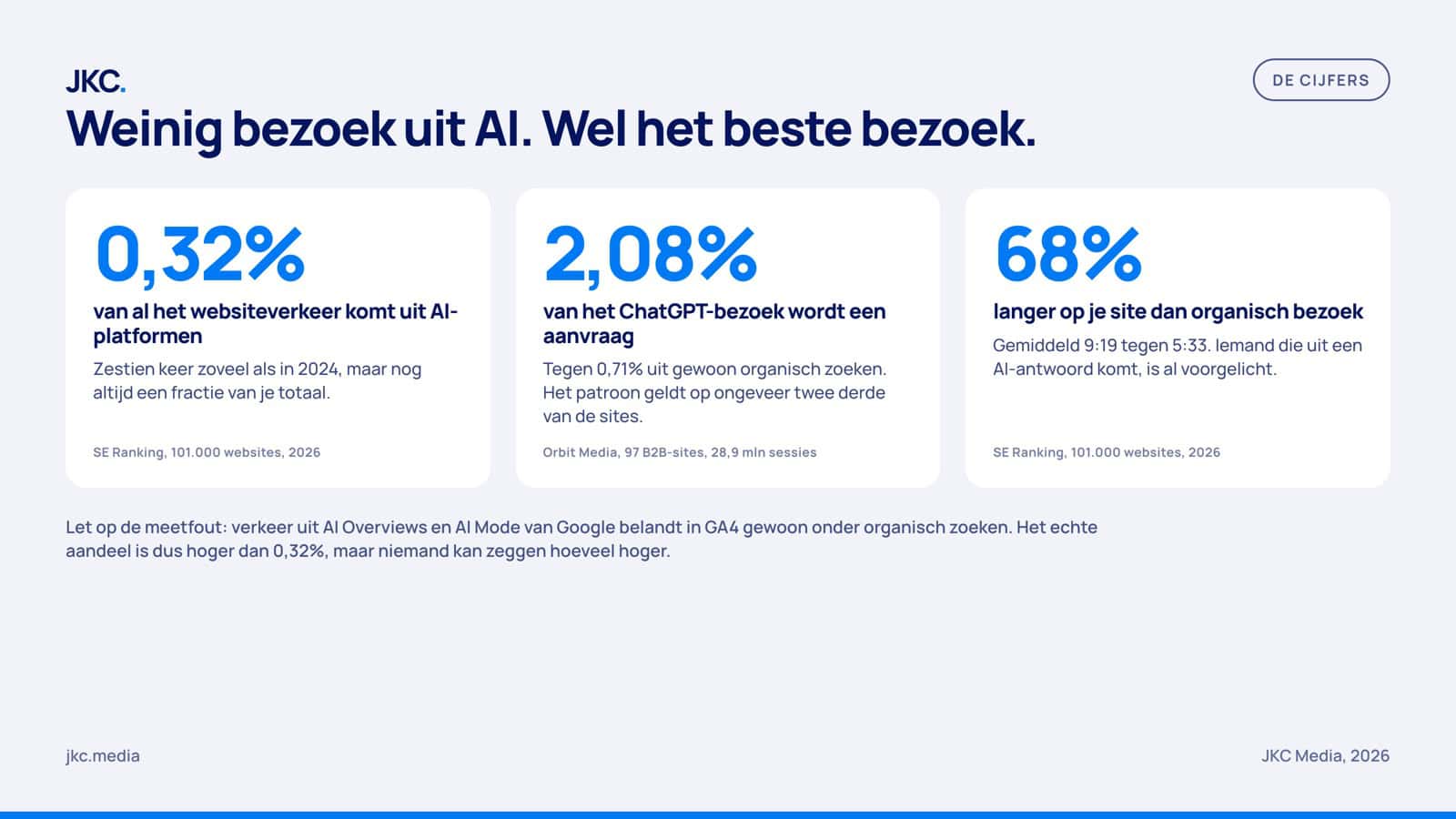
First, the volume. AI platforms currently deliver 0.32 percent of all website traffic. That is sixteen times as much as in 2024, but still a fraction of your total. Visitors who arrive from an AI answer do stick around noticeably longer: 9 minutes and 19 seconds on average against 5 minutes and 33 seconds from ordinary organic search, or 68 percent longer. That comes from an SE Ranking analysis of 101,000 websites.
Second, the conversion. Orbit Media analyzed GA4 data from 97 B2B and lead generation websites covering 28.9 million sessions between July 2025 and June 2026. Traffic from ChatGPT converted into an inquiry in 2.08 percent of cases there, against 0.71 percent for ordinary organic Google traffic (Orbit Media). The researchers are honest about the limitations themselves: the pattern holds on about two thirds of the sites, not on all of them, and the way conversions are categorized differs per site.
Third, adoption in the Netherlands. In 2025, 39 percent of Dutch people aged 18 and over had used AI in the previous three months to create text, images or video, against 23 percent a year earlier. Among companies it varies sharply by size: of companies with 500 or more employees, 59.2 percent use AI technology, while for companies with 10 to 19 employees it is 17.8 percent (CBS).
That last breakdown is the most interesting figure of the whole list for B2B. It is precisely the large organizations, where the buying processes and the budgets sit, that already have AI in their daily work. So your decision maker is already in that conversation, even though that conversation still produces barely any measurable traffic.
And then the figure you cannot pin down anywhere. There is a lot of noise about “a third of all searches already go through AI”. We have not been able to get that claim substantiated, so we do not use it. What is true: traffic from Google’s AI Overviews and AI Mode simply lands in the organic search category in GA4. So the real share of AI-influenced searches is higher than what you see in your statistics, but nobody can say how much higher. That is a reason to get your measurement in order, not to make up a number.
B2C: this is where the math will add up first
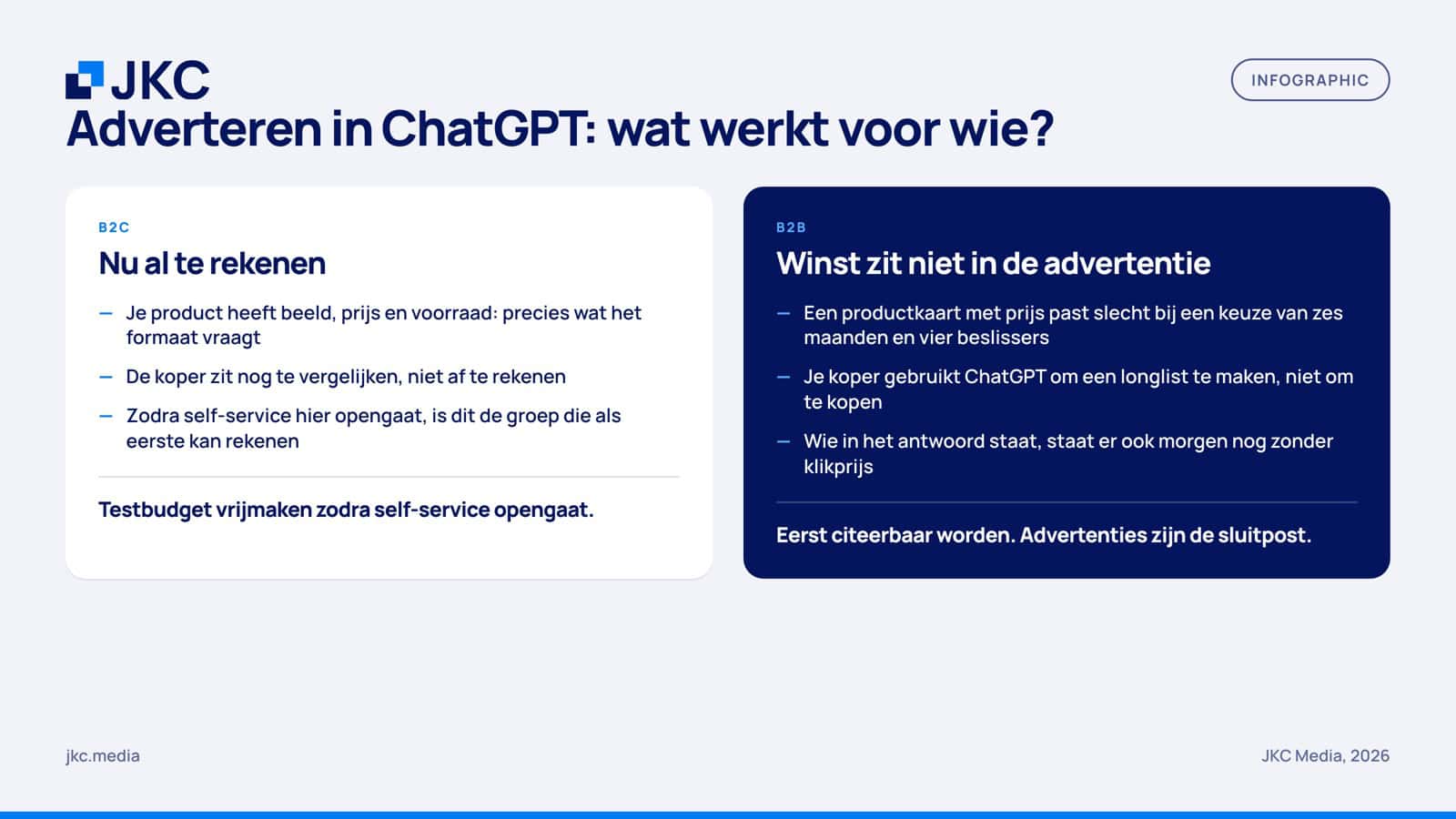
If you sell products to consumers, this channel is remarkably well built for you. You have an image, a price and stock, and that is exactly what the product format asks for. Your buyer is in ChatGPT comparing, not checking out, which is annoying for your last-click report but works fine as long as the rest of your funnel is in order. And a click price of 2 to 3 euros is a number you can test: set it against your margin per order and you will know within an afternoon whether it can work.
Three things determine whether it will work for you. Your product feed has to be right, because without a current price and stock level you will end up with an ad that does not deliver what it promises. You have to be able to see AI referrers separately in your statistics, otherwise you will attribute the result to the wrong channel. And you have to accept that the first weeks of this channel are more expensive than the weeks after, because there is no bidding history and no benchmarks yet.
B2B: the gains are not in the ad
If you sell a service, an implementation or software to other businesses, our advice is more sober. The format does not fit your purchase. A product card with a price says little about a choice that takes six months, passes four decision makers and ends in a conversation. Your buyer uses ChatGPT to build a longlist and to sharpen their own requirements, not to buy.
That is not bad news, because it is exactly in that longlist phase that you gain ground without a click price. Whoever is named in the answer itself is still there tomorrow. Whoever buys their spot there loses it the moment the budget stops. So for B2B the gains are in becoming citable: your own figures, real cases, explanations that cannot be summarized from ten other sources. We have written before about what does and does not work there according to Google, including the GEO myths you can ignore.
And the other AI tools? Not everyone wants ads
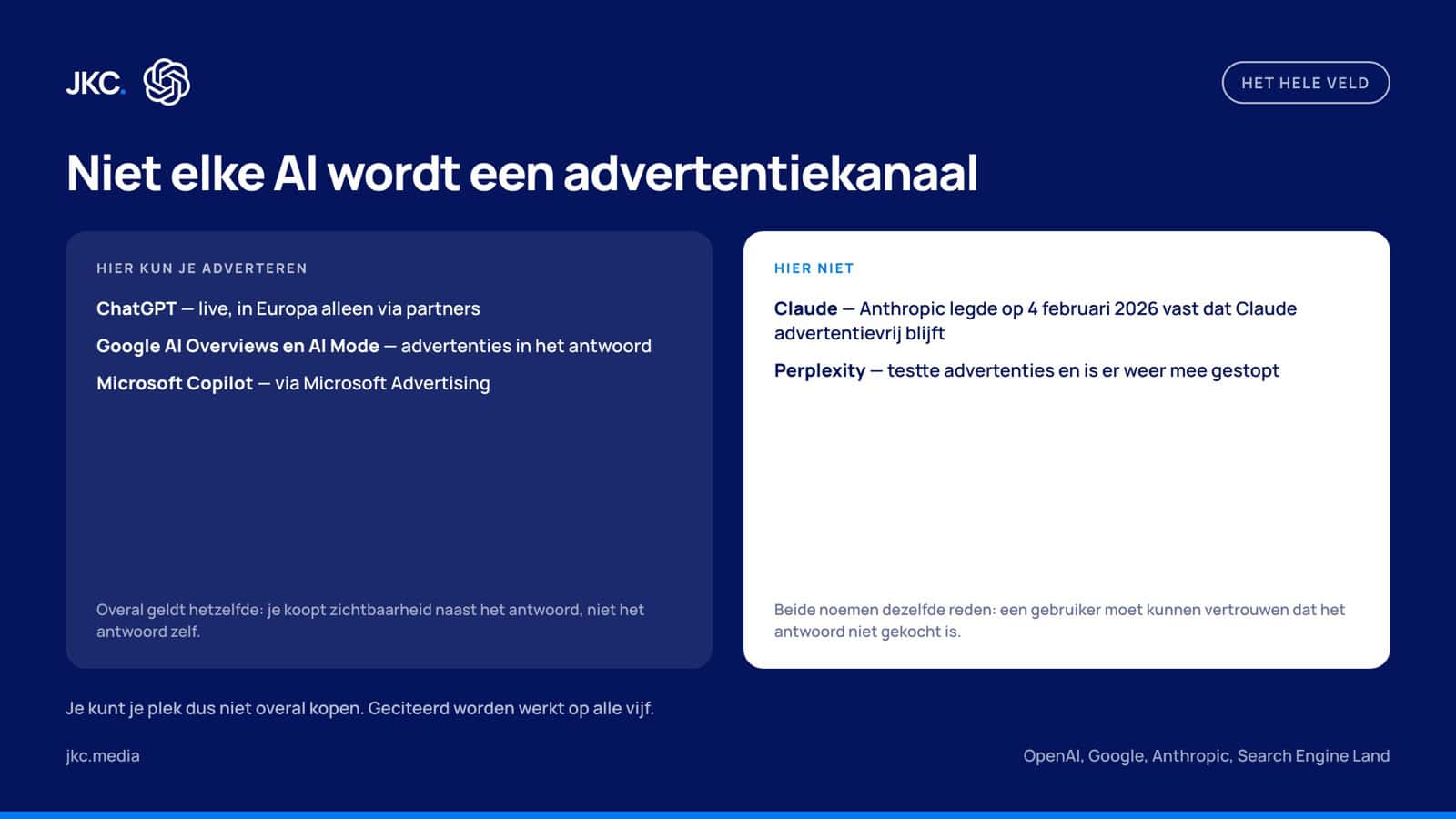
Anyone writing an AI advertising strategy right now often does so as if every platform takes the same route. That is not what is happening.
Google is the furthest along and the least exciting: there are ads in AI Overviews and in AI Mode, bought through the campaign types you already know. Microsoft Copilot serves ads through Microsoft Advertising, so there too it is more an extension of existing buying than a new channel.
On the other side are two companies that are deliberately not going there. On February 4, 2026, Anthropic publicly committed to keeping Claude ad-free: no sponsored links next to the conversation and no product placements in answers. The reasoning is notably substantive. According to Anthropic, a conversation with an AI assistant is fundamentally different from a search query, because you share personal context in it, and ads that influence the answer make it impossible to tell whether a recommendation has a commercial motive (Anthropic). Perplexity arrived at the same outcome by a different route: it tested ads and then stopped, because even a clearly labeled sponsored placement casts doubt on the objectivity of the answer (Search Engine Land).
For your own planning that matters more than it seems. Business users are often exactly the ones on the paid plans and on the assistants without ads. That is precisely where there is nothing to buy, and where the only way to appear in the answer is for your source to be good enough to be cited. One tactic works on all five platforms, and that is not advertising.
What this means for AI search and GEO
There is a pattern in this news that goes beyond one advertising product. Every search channel that grows big goes through the same sequence: first there is organic space, then advertising space arrives, and after that the organic space slowly shrinks. Google took two decades over it. In AI answers it goes faster, simply because the business model is part of it from the start instead of being added later.
What does that mean in practice? That the period in which you can appear in AI answers for free is a finite one, and that it is running now. We see that as a reason to invest in the organic side now, not to open an advertising budget. A position in the answer that you earn with your own knowledge cannot be outbid by a competitor with a bigger budget. A position you buy can be.
That is also why we watch this so closely ourselves. We keep an eye on the market around us and advise our clients on what is possible, because the options change every quarter. But our focus stays on sustainable, organic growth, without depending on bidding strategies, click prices and algorithm changes you have no influence over. Advertising is an instrument, not a foundation. What else we think about that is set out in our view on AI.
What we are doing for our clients this month
Concretely, and in this order:
- Set up measurement. Separate out AI referrers in GA4 and in the reporting, so that in three months you have a real trend line instead of a gut feeling. Without this you will not be able to say anything later about whether this channel did anything.
- Increase citability. Answers to the questions your customers really ask, with your own figures and concrete examples in them, and a structure that both visitors and models understand.
- Clean up product feeds for webshops, because that is the precondition for the product format and it already delivers better results in Shopping today.
- Get a test budget ready, do not spend it. We are deciding now which amount and which audience we would test as soon as self-service opens, so that you can then go live within a week instead of within a quarter.
- Take nothing away from what works. Not one euro out of a campaign that performs, not one hour out of content that ranks. A test is funded from headroom, not from results.
In short
The ads have been rolling out in the Netherlands since August 24, but you cannot buy them yourself here: in OpenAI’s own list the Netherlands is marked Coming Soon, just like the other 30 European countries. And it is no law of nature that every assistant becomes an advertising channel: Claude and Perplexity are deliberately keeping their answers ad-free. For webshops it is a realistic test channel as soon as that changes, with a click price you can test against your margin. For B2B it is for now a reason to work harder on your organic position in AI answers, because that is where your buyer already is. And for everyone: make sure you can measure it before you start reporting on it.
Want to know how your company currently stands in AI answers, and which of these five steps will do the most for you? We are happy to take a look with you, without you having to free up an advertising budget for it. Get in touch and we will schedule half an hour to go through your situation.
Rather hand it off? See how we help with advertising in ChatGPT and AI and Google Ads.