
A Request for Proposal is a request for a solution from several parties, in which you describe the situation and the question, including any additional conditions. Companies and organizations use one to make the tendering process more efficient, for example when commissioning a new website. How do you write a good RFP for your website? You can read all about it in our new blog.
What are RFPs?
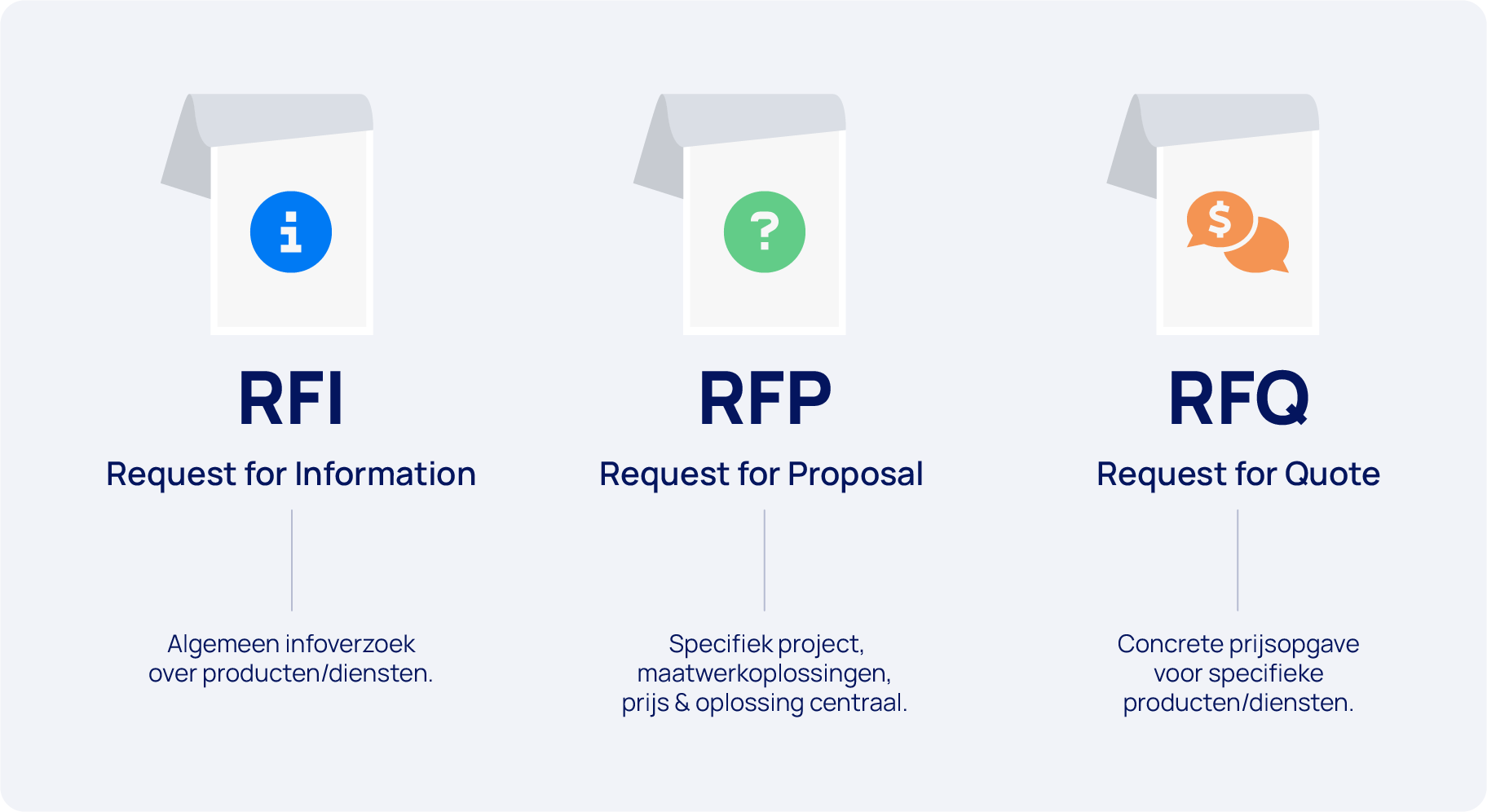
With a Request for Proposal you put your project to several parties. As the client, you describe the situation and the question, including any conditions that apply. This gives you a document that describes the project and lets you collect various solutions from different parties. A party you approach responds to your RFP in writing with a solution. That way you can compare several solutions and see what suits your company best. On top of that, you create a level playing field for every party you write to. There are different documents to choose from for your project or question:
Who are RFPs useful for?
Using an RFP is mainly useful for larger companies and organizations, because it simplifies the tendering process and drawing one up usually takes a fair amount of time. But nothing stops smaller companies from writing an RFP for their projects. With an RFP, a company can make a well-considered choice about which party and which solution fits best. Who can you send your website RFP to? Search online for the parties that are interesting to you and read reviews. Look at which sites you find attractive and check who built them. If you have specific technical requirements, look specifically for parties that handle those parts, so you know for sure the partner can get to work on them. When is an RFP a less practical tool for your company? If you do not have enough staff available to give feedback, no project manager to pick up the project, or simply not enough time to assess all the solutions and options.
How do you draw up an RFP for your new website?
Although you are probably not very at home in the world of website development, it is important to write down clearly what you are looking for in the new website and what your expectations are. Keep an RFP for your website simple and clear, not a document dozens of pages long. Do not be too vague, or you cannot expect a fitting solution to the problem. But if you are too detailed, you limit the freedom and creativity the party you approach has to arrive at a solution. After all, they work on web development every day and know better what is possible: ask them for advice instead.
Think about an exit strategy
Include an exit strategy in your website RFP as well: what if the collaboration no longer works out? Can you move to another party then? JKC works with WordPress, an open-source CMS (public, not licensed) that powers more than 43.5% of the internet worldwide. Because we use WordPress, there is no vendor lock-in and another party can take over the maintenance and further development if needed. Working in a proprietary CMS has certain advantages for you as a company, but it does make you completely dependent on it.
These are the important parts of your RFP:
- Introduction
- About your company You are not the only one entering into a collaboration: they are too. Tell them more about your company so the party you approach can also decide whether they want to work together or not. Drawing up an RFP, but answering one as well, takes time, so it is important for both parties to see what the expectations are and whether it is a match or not. Briefly explain what your company does and who your target audience is. That personality also influences how the website comes about and what the end result looks like.
- The goal of your website Make sure your question is clear: what will be the goal, or the goals, of the new website?
- Status of the current website Take a close look at the current website and see what is not working well at the moment. Be honest about it; that is the only way the web developer knows where to make improvements.
- Scope Determine the scope of the project: what are the required characteristics or functions of the new website? Think of specific technical functionalities.A few example requirements are:
- Flexibility: being able to make changes to your website yourself
- Speed: measured with objective software such as PageSpeed Insights or GTmetrix.
-
- Security: 2FA, two-factor authentication
- Integrations: working with your current CRM (customer relationship management) or ATS (applicant tracking system)
- Privacy: data processing agreement, cookies, cookie banner, Consent Mode V2, tracking with Google Tag Manager and Google Analytics
- SEO: optimizing how easily you are found in Google
- Content migration: what happens to the current content on your website?
- Copywriting: are you supplying the texts yourself, should the party you send the RFP to do this, or do you go for a hybrid solution?
- Specifications for eCommerce, where this applies
- Expectations and requirements Set the expectations clearly: what is needed and what is optional? Name a few websites you find attractive and explain why, and mention a few competitors. State what the creative guidelines are for the party you approach.
- Project planning and deadlines Give the project planning and key deadlines in broad outline. When does the project start, what are the important milestones and what is the desired delivery and go-live date? For example, also describe how the team works and the team roles within your company.
- Budget: not mandatory Including a budget in the RFP for your website is not mandatory. It is smart to build your budget up in modules so that you have insight into how the price is made up and can choose not to carry out certain parts, should that be necessary.
- Assessment criteria and submission instructions What will you assess the proposals on (think of expertise, skills and way of working), what should the proposal consist of and how should it be submitted?
- Contact information Where the party you approach can ask questions if needed.
Submit an RFP for your website to JKC
Looking for a website development partner for your company? We have clients across the country and plenty of experience with larger projects. We will draw up a quote for you without obligation once you submit your website RFP.
Send your RFP to us by email.
Rather hand it off? See how we help with having a website built and a digital strategy.
More articles
- How and why to apply an employer branding strategy to your website 17 July 2024
- 5 techniques to get more revenue out of your website 18 July 2019
- Ingredients for the perfect website 10 December 2018