

Protecting the consumer in online sales
Online sales have become impossible to imagine our lives without. We search online every day and drop a product into our shopping cart with a single click. No wonder, then, that strict rules apply to webshops. And more requirements are on the way. On 28 May 2022, new rules take effect under the European directives. What it comes down to is that, as a webshop owner, you have to provide more information and be more transparent toward consumers.
What happens if you do not follow the new rules for webshops?
Those rules exist for a reason. There are plenty of stories out there about bad buys and fraud through webshops. These rules protect the consumer in online sales. If you break the requirements as a webshop owner, there are consequences. You will have the Dutch Authority for Consumers and Markets (ACM) and the Dutch Authority for the Financial Markets (AFM), the watchdogs for these markets, on your back.
The consequences are no small matter. The authorities can set you a deadline to implement the rules after all, or send a fine your way. And that fine can add up quickly: from 4% of your annual revenue up to 2 million euros if no information about your annual figures is available. So it is smart to take a closer look at those new rules with our step-by-step plan.
The step-by-step plan for an up-to-date webshop
Grab our step-by-step plan and work out which rules matter for you. That way your webshop is fully up to date and you will not find any fines on your doormat.
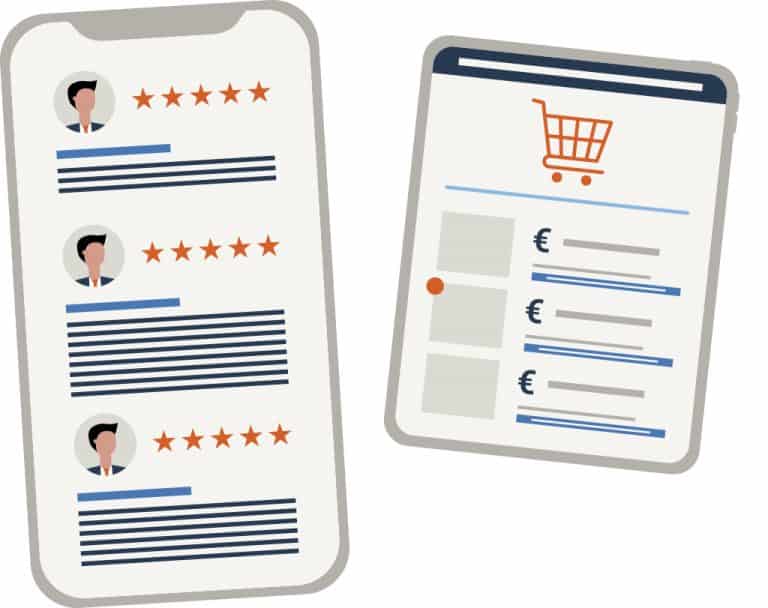
- Do you show reviews in your webshop? Reviews play a big role in a consumer’s purchase decision. That is why it is important that customers have all the information about those ratings. As a webshop owner you have to provide more information about how you collected those reviews. Think of the following points:
- State whether and how you check that customers really bought a product or service and are therefore giving an honest review.
- Indicate whether you process both positive and negative reviews in order to give a truthful picture of the product.
- State whether you have paid customers or offered them anything for posting a review.
- Do you offer customers personalized offers? You want to offer your customers an assortment that fits their search as closely as possible. To do that you look at things like what the consumer has searched for and bought before, where they live and other characteristics. Inform customers about this before they make a purchase, for example with a pop-up or a message on the payment page.
- Do you work with discounts in your webshop? Discounts are a good incentive for customers to go ahead with a purchase. Under the new rules, from May onward it is forbidden to pick an arbitrary price when offering discounts. You are still allowed to put competitors’ recent prices or the recommended retail price on your website. If you compare your own prices, use the lowest price you charged in the past 30 days.
This rule was introduced to stop webshop owners from pushing the price up and then applying a discount the following week. After all, that is not fair to consumers.
- Do you offer your customers free online services? You do not only offer your customers products, you also give them the option to sign up for free online services. Think of social media or newsletters. State how long consumers will use this service and explain how they can unsubscribe. They also have the right to cancel within 14 days without giving a reason. And as soon as the unsubscribe is complete, you have to stop processing the customer data and delete it.
- Is your webshop an online marketplace or a comparison site? These two types of webshops have to give visitors more information. On an online marketplace, for example, it has to be clear to consumers who they are buying from before they check out. Are they buying from a private individual or from a business? And what are the terms and conditions? Besides that duty to inform, as the owner of an online marketplace you have a duty to investigate: make sure you request all the legal information and terms from the sellers on your platform in advance.Comparison sites face a broader duty to inform as well. When consumers compare products or services through your website, you have to make clear to them before the purchase how the search result came about. You can leave out all the technical algorithms. What you do have to mention is, for example, whether companies pay to rank higher.
Rather hand it off? See how we help with having a webshop built.
More articles
- 9 tips for more conversions on your online job postings 11 October 2022
- Content for your website: 5 tips for better online results 13 December 2022
- Online findability: the basis of everything you do digitally 22 May 2026