

Tip 1: Make sure your online store is lightning fast
Your online store has to be lightning fast. Speed has been part of Google’s algorithm since 2010, and in recent years it has become even more important. You would most likely have skipped our website if you had to wait a long time for it. Unfortunately, the same goes for your website.
The fact that the site loads quickly on your computer does not mean it does for everyone. We make sure your website is blazing fast for everyone.
Let us explain that. Since you no doubt visit your own website regularly, the browser you use stores a “cached” version of the site. That way your own computer can load a frequently visited website faster. Handy, but not good for testing the speed of your website. Fortunately, there is a solution. These days you can easily test the speed of a website with online tools such as GTMetrix or Pingdom Tools. Those test servers, however, are usually not located in the Netherlands. And if you have a Dutch website for a Dutch audience that is hosted in the Netherlands, a test like that is of course slower than normal. Even so, it can give you a good picture of which improvements are needed. Read more tips here for a lightning fast WordPress site.
Tip 2: Pay attention to how easy you are to find in Google (SEO)
If you work on your Google visibility the right way (also known as SEO), it can help potential customers find you more easily online.
Potential customers do not know you exist if they cannot find you, or if they have to make a lot of effort to do so
A few things you can easily do are, for example:
- A thorough keyword analysis (using the ‘Keyword Planner‘ in Google Ads) and optimizing your website for those keywords in a ‘natural’ way;
- Asking other websites to mention your site;
- Keeping your website up to date regularly, for instance with new products and blog posts;
- Writing guest articles on other relevant websites;
- Adding ‘rich snippets’ to your product pages (‘rich snippets’ are pieces of code that give Google information about your page or product);
- Adding the online store to Google Search Console and ‘fetching’ it often, which speeds up indexing in Google;
- Signing up for ‘Google Shopping’ and the ‘Google Merchant Center‘ (tip 15);
- Creating an XML sitemap and submitting it to Google in your Search Console;
- Writing good meta titles and meta descriptions

Guest articles in particular are a good way to optimize your website for specific keywords. This article, for example, is focused on the keyword “marketing tips online store”. You can read which SEO tricks you should not apply to your website in one of our earlier blog posts. If you apply these marketing tips for your store’s Google visibility in the wrong way, for instance by using outdated tricks to optimize your website for certain keywords, it can actually backfire on your store.
Blog posts are an important part of your SEO strategy
The value of writing blog posts is still badly underestimated by online stores. Blog posts are a good way to inform visitors about the products your store sells, for example. On top of that, articles on your blog are easy to optimize for keywords in Google. You can use them to generate new traffic and revenue. With an online store there are plenty of topics to blog about, for example:
- New items in your store
- New features in your store
- News and updates that are relevant to your store’s industry
- A review of one of the items in your store
Struggling to write blog posts? We are happy to take that off your hands. Read more about our content creation.
Tip 3: Build good landing pages
Using keywords for SEO is not the only thing that makes your website easy to find in Google. Good landing pages are part of it too. By doing SEO research you find out which terms are important and popular. Make sure your texts are at least 300 words long. Google then sees your texts as important, which helps you rank higher.
Good landing pages lead to a higher ranking in Google. We are happy to create them for you.
Also make good use of subheadings: <h1>, <h2> and sometimes <h3>. Put popular keywords in those headings. Finally, it also helps to build landing pages that offer specific products, so ideally a separate landing page for every product. That can be a lot of work, which is why you can also decide to highlight only the categories or brands. That way your landing pages contribute to a higher ranking in Google. Besides product pages, landing pages for towns and regions are a nice addition as well. They let you focus on local keywords. Does your store deliver throughout the Netherlands, and would you like to target a large number of regions and cities? By working with spin text you can create a wide variety of texts in no time. Writing the base text takes time and effort, but with a decent number of landing pages it definitely pays off.
Tip 4: Optimize your conversion
With websites and online stores this term keeps coming up: conversion optimization. The conversion rate is the share of visitors who actually take the intended action, such as making a purchase or signing up for the newsletter.
Make sure your visitors take action with clear CTAs. In our website development we always pay close attention to a good CTA.
You can optimize your conversion by starting with research into the right colors and layout for so-called Call To Actions. These include buttons with catchy text that prompt the visitor to take action. If that button is tucked away in a corner of your site, you miss out on a lot of conversion. So pay close attention to that.
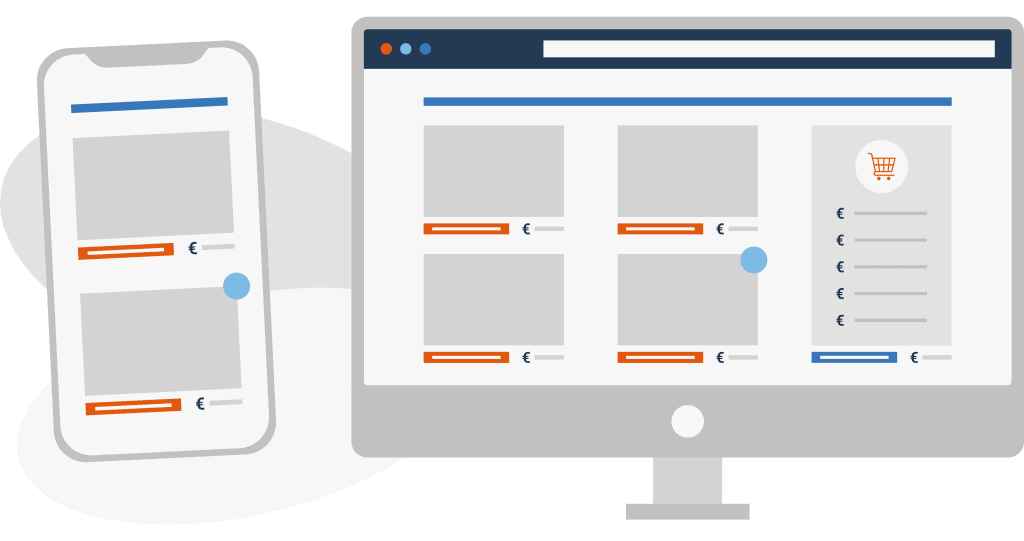
The best approach is to use A/B testing. You then have two versions with (small) differences between them and test which version works better. This method only makes sense with large amounts of traffic, though, so that the difference is clearly visible. In our blog post we explain in more detail how to measure and improve your conversion rate.
Tip 5: Put social media to work
Especially in the early days of your online store, social media is a handy way to make people aware of the store, promote your products and improve your store’s online identity. It is important to go about it the right way, so that you get the most out of your business social media. Let us start with which social media channels are useful, because that can differ a lot per store. If you sell office supplies to businesses, you are better off focusing on LinkedIn and Facebook. If your store sells sneakers and trendy clothing, focus more on Instagram, Facebook and perhaps even Snapchat. If you decide not to use a particular social media platform actively, at least make sure you have a business profile on it. That way you prevent someone else from posing as your company on that platform.
Find out which channels your target audience uses
Now it is time to reach the right audience. Post cool things such as:
- Deals and promotions
- New items (such as a new collection)
- Customer reviews
- Updates related to your store and its products
Out of inspiration for your socials? Or are you getting a little tired of posting? We are happy to take over by creating your content.
Tip 6: Remarketing, remarketing & remarketing
Remarketing is very important but often forgotten. It means reaching potential customers and visitors (of your online store) again. The more often your potential customer sees your company around them, the sooner that person is inclined to buy something from your store. You can probably remember it yourself. You once looked online for a holiday or a car, and suddenly you get ads on Facebook and other social media channels about booking a holiday or leasing a car. That is an example of remarketing. Two examples of how you can use remarketing for your business:
- Creating ads on Facebook and so on, targeted at people who have visited your website at some point (tip 14)
- Giving people the option to sign up for a newsletter
The important thing with remarketing is not to annoy the potential customer. Keep it low pressure and do not push too hard, that way potential customers stay positive about your store.
Tip 7: Offer deals and be personal
Almost every website or online store uses special offers now and then. That makes sense, because they work extremely well. Offers trigger visitors to make a purchase sooner, and that is your goal as a business. Do not overdo it, because that can actually make customers suspicious and keep them from buying from you. But an offer every once in a while gives your site or store a boost. Coolblue is still the leader in personal communication with customers; adding a personal handwritten note to your customer’s order is a good example. On social media there are hundreds of customers showing their appreciation for Coolblue (free promotion). Another idea is to add a small, free gift to the order. Or come up with something creative yourself that fits your store and surprises your customer.
Tip 8: Highlight your shipping costs & return policy
For consumers in 2022, free shipping is pretty much the standard. If you charge shipping costs for the same product that your competitor offers with free shipping, you will most likely lose that potential customer. Shipping costs you money. But you can build those shipping costs into your product price, for example. That way you still recover the money you spend on shipping, and the customer has the feeling that they are not paying extra for it.
Customers may drop out if they only find out about the shipping costs later on
Whether returns are free or paid depends on the type of store you run. In a store that sells clothing, returns happen more often because customers order two sizes, for example. If customers have to pay 6.95 euros to return an item, they often drop out and order from another store instead. In a store that sells electronics, people are less likely to drop out if returns cost money. After all, people return items less often at an electronics store than at a clothing store. And highlight this information. Nobody likes being about to pay for a purchase and then seeing another 10 euros in shipping costs added. Make it clear in an extra information tab or in your Unique Selling Points (USPs) what the shipping costs and return policy are. That reduces uncertainty among consumers and increases the chance of a purchase. Is shipping free above a certain amount? Let the visitor know that too. Add a pop-up on the homepage that tells the customer how much more they need to order for free shipping. Especially if it is only a small amount, that can push customers over the line and get them to add an extra product to the cart.
Tip 9: Selling on Bol.com
Especially if your online store is brand new, it can be lucrative to sell through platforms such as Bol.com. A platform like Bol.com enjoys a lot of trust among Dutch consumers, and it is easier for an existing bol.com customer to order your products.
Bol.com is highly trusted, which makes customers order there quickly
Selling through platforms such as Bol.com costs money. It does save you marketing and transaction costs, though, and it brings in new customers as well. The Bol.com business selling website also lists the commission fees per purchase. There is a good chance that if bol.com customers have a good experience with you as a seller, they will order directly from you more often afterwards.
Tip 10: Integrate Facebook & Instagram shopping
We have been seeing Facebook & Instagram shopping more and more in recent years. You use these social media to offer your products there by integrating your products or store with the platforms. These services are completely free and easy to use. Especially when your target audience spends a lot of time on these platforms, it is smart to get started with them.
No idea how to do that? We will take care of it for you.
Tip 11: Use WhatsApp Business
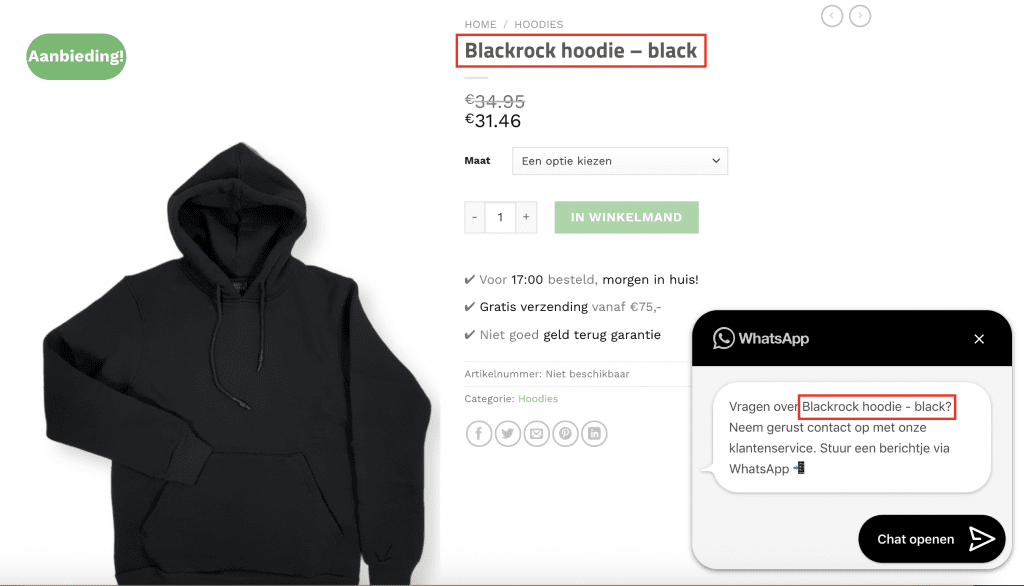
The same goes for WhatsApp Business. It lowers the barrier for getting in touch with visitors. Customers can see that they are really messaging your company. It is a fast and familiar way of communicating, but it still stays professional. With the app’s business tools you can do all sorts of things: away messages, showing your contact details, automating quick replies and so on. You can also offer product specific information through WhatsApp. For example, add a pop-up that appears after a few seconds, tailored to the product the visitor is looking at, as in the example below. That makes things easier for the customer, and these days that is extremely important.
Tip 12: Make use of affiliate marketing
Affiliate marketing means that a third party promotes your item or product. In return you pay money for every order from customers who reached your store through that third party. Service providers such as Daisycon bring advertisers (you as an online store, for example) and publishers (bloggers, news websites and so on) together. Affiliate marketing is suitable both for generating more revenue and for building brand awareness and a good link profile (for your Google visibility).
Tip 13: Do email marketing
As briefly covered earlier, email marketing is a good way to get both existing and potential customers to place (new) orders in your store. You can automate email marketing with software such as MailChimp (with WooCommerce), for example for the following things:
- Automatic reminders for abandoned carts, with a discount code for instance. This method is used a lot;
- An automatic email after an order comes in, asking for a review and offering a discount code;
- Personalize and design your automated emails. Think of a personal salutation in the order confirmation, or using a particular logo, font, colors and so on.
A good way to make use of email marketing is to place a newsletter sign-up form in the footer of your website, or to let customers sign up for the newsletter with a single checkbox (opt-in) when they place their order.
Tip 14: Invest in social media advertising
Look into advertising on social media platforms as well. It is usually a lot cheaper than Google and very efficient for certain types of campaigns. You can set up ads through LinkedIn, Instagram and Facebook, for example.
Find out who your target audience is and where to reach them
With LinkedIn’s Campaign Manager, for example, you can set up an ad in no time. You decide who sees your ad. Define a target audience and pay attention to things like:
- Gender
- Age
- Location
- Job title
- Interests
You reach people who do not follow you (yet), which means potential customers see your products or services. Create several ads, look at the results and get the most out of social media advertising that way. You also have plenty of choice in the type of ad you want. Will you go for an image, a video or maybe a stories ad? You do not have to start with a huge budget either, you can experiment first and see what works well for you.
Tip 15: Get started with Google Shopping Ads
Advertising through Google is essential these days. Besides Google Ads, take a look at Google Shopping Ads. These are the product ads you see at the top of a search or in the separate ‘Shopping’ tab.
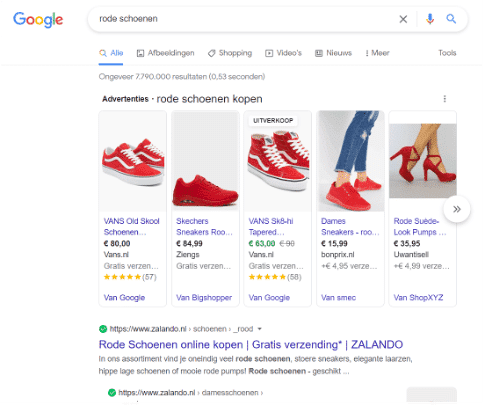
Through Google Shopping, consumers immediately see products from different sellers. So it is important that your products or services are among them. Instead of selecting keywords as you do in Google Ads, with Google Shopping Ads you use your product feed. To get started with your product feed in the Google Merch Center, you first have to create a Google Ads account. After that you can start with your Google Shopping Ads.
Tip 16: Make checking out as simple as possible
Yes: a visitor has put your product in their online cart. All that is left is the checkout. Make sure you do not lose the customer there. Make the payment process as easy as possible, ideally within a single click, without hitting the customer with extra unexpected costs.
Do not lose customers to a long or complicated payment process
You can boost your conversion further by giving customers several options at checkout. iDEAL, credit card and PayPal are must haves, but also think about pay later options such as AfterPay or Klarna.
Tip 17: Make sure your online store complies with the rules
When you run an online store, you have to comply with the law. For instance, you have to state certain information. Think of:
- The name of your business
- The address, phone number and email address of your business
- Your registration number with the Dutch Chamber of Commerce (Kamer van Koophandel)
- Your VAT identification number
- The terms and conditions and privacy statement
- The shipping costs
- The cooling-off period and warranty
There are privacy rules as well. Always ask for permission when you collect user data, for example.
Avoid hefty fines and check the rules for online stores
The world of legislation keeps changing. In July 2021, for instance, the VAT rules were changed for online storesthat delivered within the EU. In May of this year a batch of new rules came into force as well. As a store owner you now have to pay attention to the following things, for example:
- Tell customers how you collect your reviews
- Give more information about your free online services (such as social media or newsletters)
- Inform customers about your personalized offers based on things like their earlier searches
- Use the correct reference prices when you offer discounts
If your online store does not comply with the law, you could easily find a fine on your doormat. Avoid fines and always check the latest rules.
Conclusion: marketing tips for online stores
Need help putting these tips into practice? Get in touch and we will gladly help you. Who knows, in a few years we may give you new tips again, because the world of online stores and websites keeps developing. We are happy to keep you up to date.
Rather hand it off? See how we help with having a webshop built and Google Ads.
More articles
- 5 essential tips to get the most out of your email marketing 4 March 2025
- Why defining your target audience matters, plus tips for your marketing strategy 7 October 2024
- 5 tips for perfect landing pages 21 June 2021